
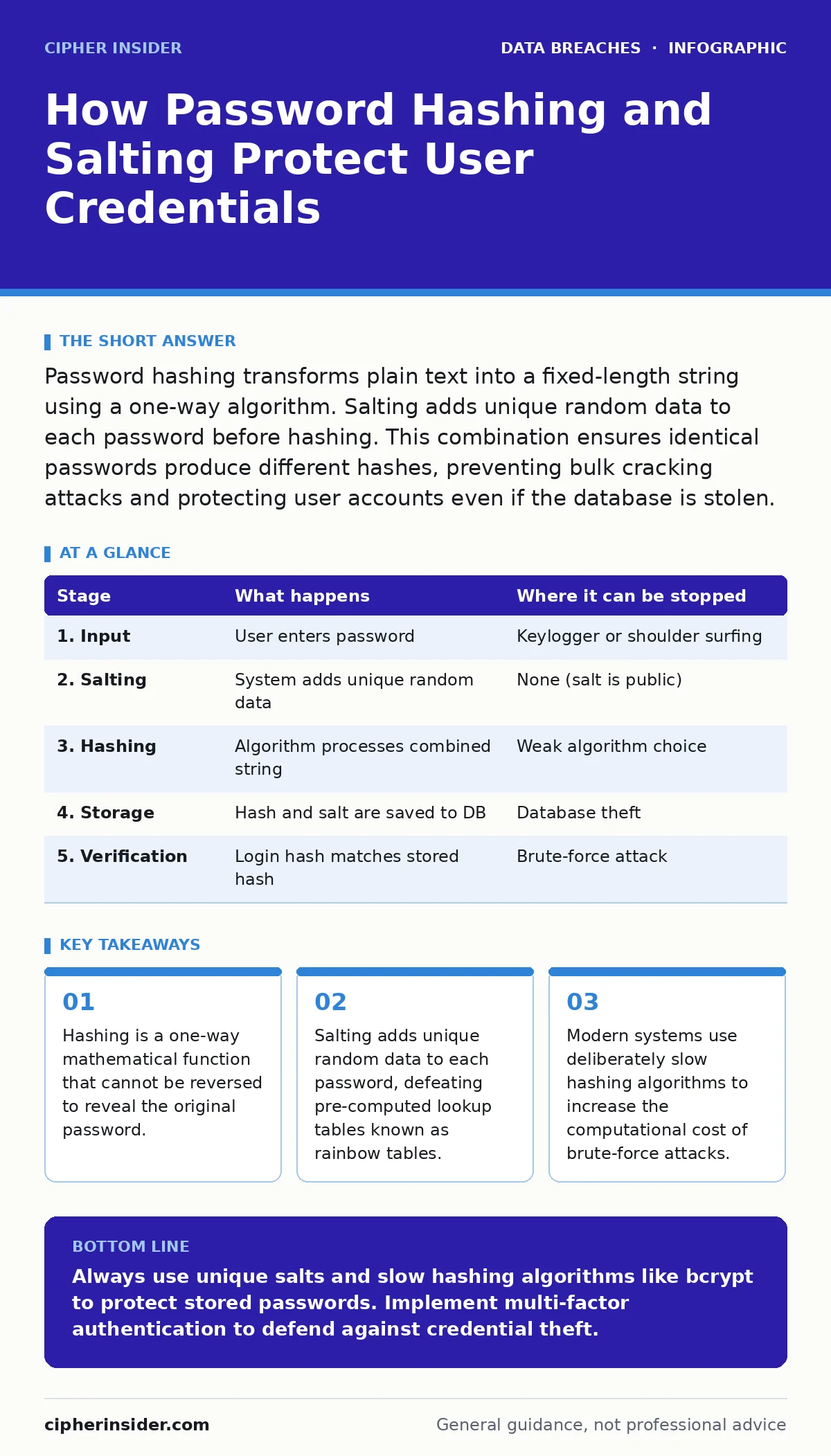
Password hashing transforms plain text into a fixed-length string using a one-way algorithm. Salting adds unique random data to each password before hashing. This combination ensures identical passwords produce different hashes, preventing bulk cracking attacks and protecting user accounts even if the database is stolen.
The Problem with Plain Text Storage
Storing passwords in plain text is a critical security failure. If an attacker gains access to the database, they immediately possess every user credential. This exposure enables instant account takeover and facilitates credential stuffing attacks across other platforms. Users rarely change passwords after a breach, assuming their data remains safe. This assumption fails when storage practices are weak. Systems must transform passwords into unreadable formats before saving them. This transformation relies on cryptographic hashing functions.
Understanding Cryptographic Hashing
A hash function takes an input of any length and produces a fixed-size output string. This output is called a digest. The process is deterministic, meaning the same input always produces the same digest. However, the function is one-way. You cannot derive the original input from the digest. This property protects passwords because the system never stores the secret itself. It only stores the proof that the secret exists. Common algorithms include SHA-256 and bcrypt.
The Threat of Rainbow Tables
Standard hashing faces a significant vulnerability: collision attacks and pre-computation. Attackers create massive databases called rainbow tables. These tables contain pre-computed hashes for billions of common passwords. When an attacker steals a database of unsalted hashes, they simply look up each digest in their table. This lookup happens in milliseconds. No brute-force guessing is required. The attacker instantly recovers the original password for any entry that matches a common phrase. This method defeats basic hashing entirely.
How Salting Defeats Pre-Computation
Salting adds a unique, random string of data to each password before hashing. This salt is different for every user account. The system stores the salt alongside the resulting hash. When a user logs in, the system retrieves the salt, adds it to the entered password, and hashes the combination. The result is compared to the stored hash. Because each salt is unique, identical passwords produce different hashes. Rainbow tables become useless because the attacker would need a separate table for every possible salt value. This makes pre-computation computationally impossible.
Choosing the Right Algorithm
Not all hash functions are suitable for passwords. Fast algorithms like MD5 or SHA-1 are designed for speed. This speed benefits attackers who can perform billions of guesses per second. Password hashing requires slow algorithms. Algorithms like bcrypt, scrypt, and Argon2 are deliberately inefficient. They consume significant memory and processing power. This slows down brute-force attempts. An attacker must spend seconds or minutes per guess. This delay makes large-scale cracking economically unviable. The trade-off is slightly slower login verification, which is negligible for user experience.
Implementation Best Practices
Proper implementation requires attention to detail. Generate a cryptographically secure random salt for each user. Store the salt in the same database record as the hash. Do not hide the salt. It is not a secret. Its purpose is uniqueness, not confidentiality. Use a high work factor or cost parameter in your algorithm. This parameter controls how many iterations the algorithm performs. Increase this value as hardware improves. Regularly review your hashing configuration to ensure it remains resistant to modern hardware.
Worked Illustration of the Process
Imagine a user sets the password "Blue123". The system generates a random salt, such as "x7z9". It combines them to create "Blue123x7z9". The system hashes this combination using bcrypt. The resulting hash is stored. The salt "x7z9" is also stored. When the user logs in, they enter "Blue123". The system retrieves "x7z9", combines it to form "Blue123x7z9", and hashes it. The new hash matches the stored hash. Access is granted. If an attacker steals the database, they see the hash and the salt. They must guess the password, add the salt, and hash it repeatedly.
| Stage | What happens | Where it can be stopped |
|---|---|---|
| 1. Input | User enters password | Keylogger or shoulder surfing |
| 2. Salting | System adds unique random data | None (salt is public) |
| 3. Hashing | Algorithm processes combined string | Weak algorithm choice |
| 4. Storage | Hash and salt are saved to DB | Database theft |
| 5. Verification | Login hash matches stored hash | Brute-force attack |
Managing Credential Hygiene
Technical controls must be paired with user behaviour. Even strong hashing cannot protect a user who reuses passwords across multiple sites. If one site is compromised, attackers try those credentials elsewhere. This practice is known as password reuse. Users should employ a password manager to generate unique, complex passwords for every account. This limits the blast radius of any single breach. Monitoring for exposed credentials helps users react quickly. Services like Have I Been Pwned allow users to check if their email appears in known breaches.
Reviewing Your Security Posture
Regular audits ensure your hashing strategy remains effective. Check that your cost factor is sufficient for current hardware. Verify that salts are truly random and unique. Ensure that legacy systems are not using deprecated algorithms. Consider the broader context of data protection. Passwords are only one layer. Implementing data loss prevention strategies reduces the impact of internal threats. Understanding third-party risk assessments helps you evaluate vendors who may store your user data. Secure storage practices must extend to all sensitive information.
The Role of Multi-Factor Authentication
Hashing and salting protect stored passwords, but they do not protect the login process. If an attacker obtains a valid password, they can bypass authentication. Multi-factor authentication adds a second layer of verification. This typically involves something the user has, such as a phone, or something the user is, such as a fingerprint. This approach mitigates the risk of stolen credentials. Even if the hash is cracked, the attacker cannot access the account without the second factor. This defence is critical for high-value accounts.
Conclusion on Password Security
Password hashing and salting are fundamental security controls. They transform reversible plain text into irreversible digests. Salting ensures uniqueness, defeating pre-computed attacks. Slow algorithms increase the cost of brute-force attempts. Proper implementation requires using standard libraries and high cost factors. These measures protect user data even if the database is compromised. Security is a continuous process. Regular review and user education remain necessary. Combining technical controls with multi-factor authentication provides the strongest defence.
Key takeaways
- Hashing is a one-way mathematical function that cannot be reversed to reveal the original password.
- Salting adds unique random data to each password, defeating pre-computed lookup tables known as rainbow tables.
- Modern systems use deliberately slow hashing algorithms to increase the computational cost of brute-force attacks.
Always use unique salts and slow hashing algorithms like bcrypt to protect stored passwords. Implement multi-factor authentication to defend against credential theft.
Frequently asked questions
Can I use the same salt for all users?
No. Using a single salt allows attackers to use rainbow tables. Each user must have a unique, random salt to ensure individual hashes are distinct.
Is it safe to store the salt in the database?
Yes. The salt is not a secret. Its purpose is to ensure uniqueness. Storing it with the hash is standard practice and required for verification.
How often should I change the hashing algorithm?
Change it when your current algorithm becomes vulnerable or when hardware advances significantly. Migrate users lazily by re-hashing their passwords on next login.
Does hashing protect against phishing?
No. Hashing protects stored data. Phishing tricks users into revealing their password. Multi-factor authentication and user training are needed to mitigate phishing risks.
How this guide was produced: written by the Cipher Insider editorial team with AI assistance, checked against the public references listed below, and reviewed when the facts change. See our editorial policy or report an error.